Anyone who campaigns for a politician, would face some consequences, but is it really anyone?
This case study examines how celebrity political endorsements in Nigeria have triggered backlash, bullying, and systemic consequences and why micro-influencers are structurally protected from the same level of damage.
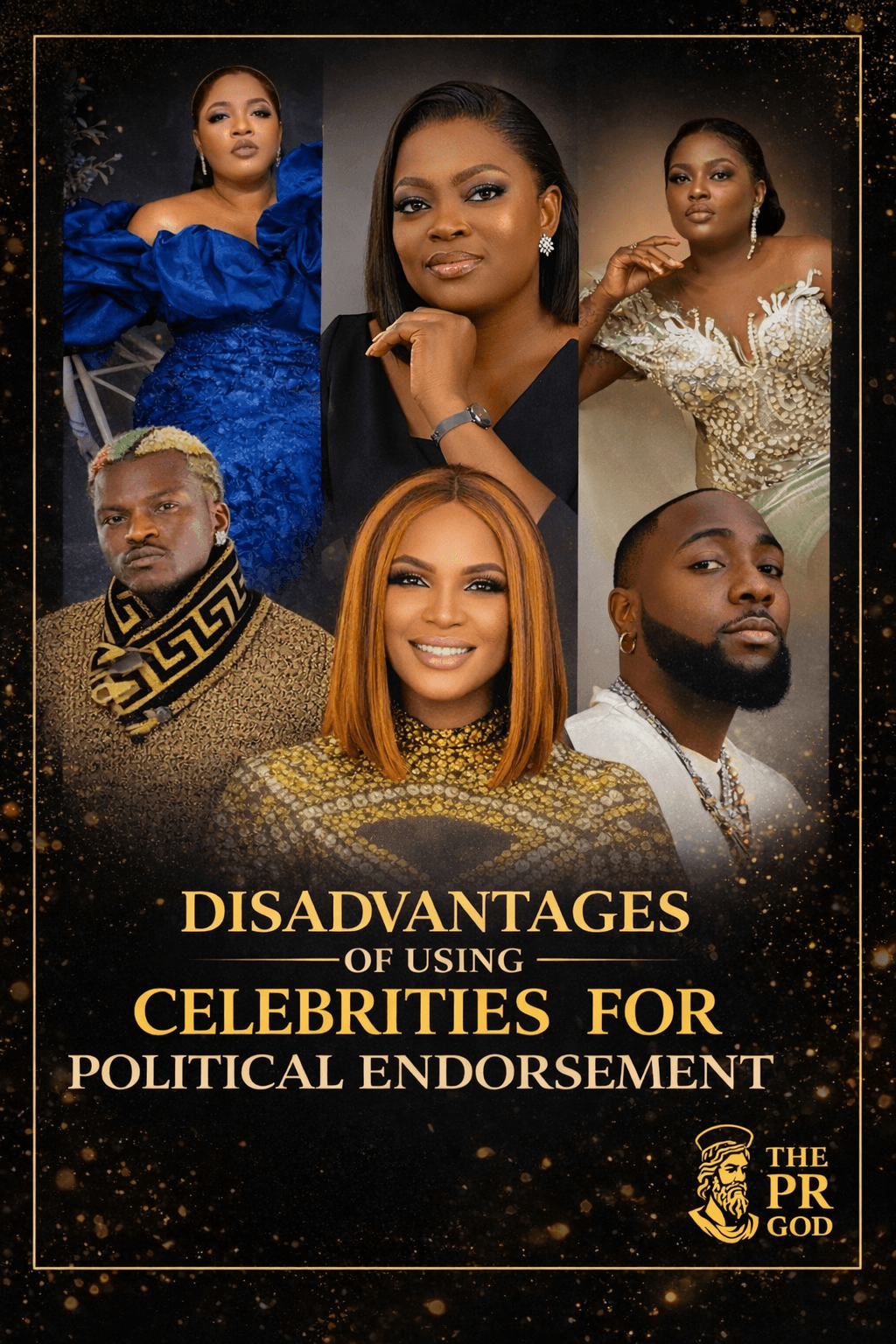
Using real-world examples involving Portable, Davido, Eniola Badmus, Toyin Abraham, and Iyabo Ojo, these Nigerian celebrities have in one way or another, engaged in politics and this analysis shows why this engagement was dangerous to their brands and why the future of persuasion belongs to a distributed, localized, micro-influencers network.
CELEBRITY INFLUENCE IN POLITICS: BACK IN THE DAYS AND NOW
Celebrity influence works on a simple assumption: If people love you, they will trust who you support.
That assumption used to hold.
But modern audiences are no longer passive admirers. They are:
• Politically opinionated
• Socially reactive
• Emotionally invested
• And very quick to punish disagreement
When a celebrity enters politics, they do not bring neutral influence. They bring baggage, expectations, tribalism, and emotional projection.
In politics, influence doesn't just persuade, it divides.
TWO CELEBRITIES, TWO POLITICAL PATHS
Let's analyse the case study where Portable, a local Nigerian razz celebrity vs Davido, a self acclaimed international modern celebrity.
Two Celebrities, Two different Political Paths, both campaigning for 2 men who are running to become the governor of Osun state in Nigeria.
PORTABLE'S CASE
Portable was hired to publicly endorse and support Adegboyega Oyetola, former governor of Osun State.
Portable's brand was perfect for the job because his brand is already controversial: he has an unfiltered personality with a lot of frequent online drama and strong street credibility.
His endorsement did not convince undecided voters. Instead, it:
• Reinforced existing political divisions
• Turned his music and persona into a political symbol
• Made him a target for mockery and dismissal
For Portable, the endorsement did not elevate his status—it narrowed his audience.
People who disagree politically didn't just reject the candidate. They rejected Portable himself.
In politics, rejection is personal.
DAVIDO'S CASE
For Davido's case, he came into the picture to support his uncle, Ademola Adeleke, during the Osun governorship race.
On paper, this looked safe:
• Family connection
• Emotional authenticity
• Massive fan base
In reality, it turned Davido into:
• A political actor
• A symbol of elite privilege
• A lightning rod for political anger
Critics framed the support as:
• Nepotism
• Abuse of influence
• Celebrity overreach
Suddenly, Davido's music, wealth, and lifestyle were no longer just entertainment—they were political statements.
The endorsement didn't just affect the election. It affected how people emotionally processed Davido as a person.
This is the hidden danger of celebrity political influence: Your art, brand, and identity become inseparable from your politics.
CANCELLATION: FANS USE THIS AS A POLITICAL WEAPON
Cancellation today is not always about wrongdoing. It is often about disagreement.
Once a celebrity publicly supports a political figure:
• Opposing groups feel justified in attacking them
• Online harassment becomes normalized
• Boycotts are framed as "activism"
This is where influence turns toxic.
For both men, Portable and Davido, influencing for these politicians negatively affected their brands.
ENIOLA BADMUS: WHEN ENDORSEMENT BECOMES PUNISHMENT
Another example is Eniola Badmus, by endorsing a politician publicly, the fans punished her for that.
Eniola Badmus openly supported Bola Ahmed Tinubu, the current President of Nigeria.
What followed next was not just criticism. It was:
• Sustained bullying
• Body-shaming disguised as political criticism
• Public vilification
• Attempts to erase her professional credibility
Her political stance overshadowed:
• Her career
• Her talent
• Her years of work
The message was clear: If you support the "wrong" candidate, your entire identity becomes fair game.
This is not persuasion. This is a punitive influence.
TOYIN ABRAHAM: FAME AMPLIFIES BACKLASH
Same thing with Toyin Abraham — Fame Amplifies Backlash.
Toyin Abraham faced a similar fate. Her political alignment with Bola Ahmed Tinubu triggered:
• Online abuse
• Threats
• Calls for cancellation
• A redefinition of her public image
Before politics, she was:
• An actress
• A brand ambassador
• A creative professional
After politics, she became:
• A political symbol
• A target
• A battleground
Fame did not protect her. Fame magnified the damage.
IYABO OJO AND PETER OBI: EVEN "POPULAR" CHOICES HAVE CONSEQUENCES
Another popular case is that of Iyabo Ojo and Peter Obi.
Here we can see that even "Popular" Choices Have Consequences.
Peter Obi was loved by many and endorsing him would mean that his fans would love you in return.
Iyabo Ojo publicly supported Peter Obi, a candidate with strong youth and online support.
Yet even with this "popular" alignment, she faced consequences.
The consequences include:
• Online harassment
• Scrutiny of her finances by the opposition party
• Tax investigations and pressure
• Increased state attention
This case is crucial because it proves a powerful point: Even when you support the "right" candidate, celebrity influence still attracts institutional and social consequences.
Celebrity endorsement turns private citizens into political actors, whether they intend it or not.
From these cases, one thing is clear. If a politician fails to emerge the winner, the celebrity is seen as a failure and the entire campaign collapses with them.
WHY MICRO-INFLUENCERS ARE STRUCTURALLY SAFER
Because Micro-influencers operate differently, they are:
• Smaller in reach
• Deeper in trust
• Embedded in communities
• Seen as "people like us"
When a micro-influencer supports a political idea or product:
• The reaction is localized
• The backlash is limited
• The conversation remains human
If one micro-influencer faces criticism:
• The network survives
• The campaign continues
• No single voice carries total risk
This is risk distribution.
A micro influencer does not get cancelled like celebrities.
Cancellation requires:
• Visibility
• Centralized attention
• Symbolic power
Micro-influencers lack all three at scale.
They are not:
• National symbols
• Cultural lightning rods
• Political trophies
Their influence is:
• Fragmented
• Contextual
• Community-based
You cannot "cancel" 1,000 small voices the way you can cancel one loud one.
This is because Celebrities attract projection. People project hopes, anger, and ideology onto them.
Micro-influencers attract trust. People listen because they relate.
Projection leads to punishment. Trust leads to conversation.
THE ECONOMICS OF INFLUENCE
If one thinks about the economics importance of using micro influencers over Celebrity endorsement:
Celebrity endorsement:
• Pays one person
• Centralizes power
• Concentrates backlash
Micro-influencer strategy:
• Pays many people
• Distributes power
• Dilutes backlash
In politics People do not want to be told what to think by elites. Celebrities are seen as elites.
They want:
• Relatable messengers
• Familiar faces
• Shared experiences
Micro-influencers provide that naturally.
THE SHIFT IN INFLUENCE
Back in the days:
• Fame equals persuasion
• Visibility equals trust
• Admiration equals agreement
Modern reality proves otherwise but today:
• Fame now increases Scrutiny
• People are more Hostile towards celebrities
• Would punish one who misleads them
ThePrGod offers a simple yet powerful micro-influencer model:
• Reduces reputational risk
• Protects individual creators
• Encourages dialogue over outrage
• Survives controversy
It is slower, penetrates better and is more durable. Its influence without casualties.
One is done showing genuinity without people believing that a micro influencer was paid to promote or campaign for a politician.
IN CONCLUSION
The stories of Portable, Davido, Eniola Badmus, Toyin Abraham, and Iyabo Ojo teach us a hard truth:
Celebrity influence in politics comes with invisible costs.
Careers are reshaped. Identities are politicized. People become symbols instead of humans.
Micro-influencers avoid this trap because:
• They are not symbols
• They are not targets
• They are not single points of failure
In a polarized society, the safest influence is distributed influence.
Not louder. Not bigger. But closer.
The future of political persuasion, brand communication, and social trust does not belong to celebrities standing alone.
It belongs to many voices, speaking carefully, within their communities.
That is why micro-influencers are not just effective. They are necessary.
Contact us if you want to use our micro influencers today on "ThePrGod.com".
Back to Case Studies
Political Campaigns15 min read•February 20, 2024
Winning Elections: Why Micro-Influencers Are Safer
Examining how celebrity political endorsements in Nigeria triggered backlash for Portable, Davido, Eniola Badmus, and others - and why micro-influencers are structurally protected.
Ready to Create Your Own Success Story?
Join thousands of brands and influencers achieving remarkable results through our platform.
Get Started Today